




By Augustino John Tendwa
The warm colours of friendship, diplomacy and shared history filled the grounds of the Embassy of the People’s Republic of China in Dar es Salaam on Tuesday evening as Tanzania joined China in commemorating the 77th Anniversary of the Founding of the People’s Republic of China.
The reception brought together senior government officials, diplomats, members of the Chinese community, business leaders, representatives of various institutions and friends of China in an occasion that was as much about celebrating China’s national journey as it was about reflecting on the enduring ties between Tanzania and China.
The Guest of Honour was Hon. Mahmoud Thabit Kombo, Minister for Foreign Affairs and East African Cooperation of the United Republic of Tanzania, who joined H.E. Chen Mingjian, Ambassador of the People’s Republic of China to Tanzania, in marking the important national occasion.
Against the backdrop of more than six decades of diplomatic relations, the gathering offered another powerful reminder of a partnership that has evolved with time while retaining the principles of mutual respect, solidarity and cooperation that have long defined Tanzania-China relations.
A Friendship Forged In History
The Tanzania-China relationship is one of Africa’s notable examples of a partnership whose foundations were laid during the formative years of Tanzania’s independence.
From the era of Mwalimu Julius Kambarage Nyerere and the establishment of diplomatic relations, the two countries developed a relationship that extended beyond conventional diplomacy.
The construction of the Tanzania-Zambia Railway (TAZARA) became one of the most enduring symbols of that early friendship, reflecting a period when infrastructure cooperation was closely linked to the aspirations of newly independent African states.
More than half a century later, that history continues to provide an important foundation for a relationship that has expanded into trade, investment, infrastructure, health, education, agriculture, technology, culture and people-to-people exchanges.
The relationship has consequently moved from the symbolism of historical solidarity to an increasingly broad and practical partnership.
Ambassador Chen: From Shared History To A Shared Future
In her remarks at the reception, Ambassador Chen Mingjian reflected on China’s remarkable journey since the founding of the People’s Republic in 1949 and the transformation that has taken place over the past 77 years.
For China, the anniversary is not simply a commemoration of the past. It is also an opportunity to reflect on the country’s development experience and its engagement with the wider world.
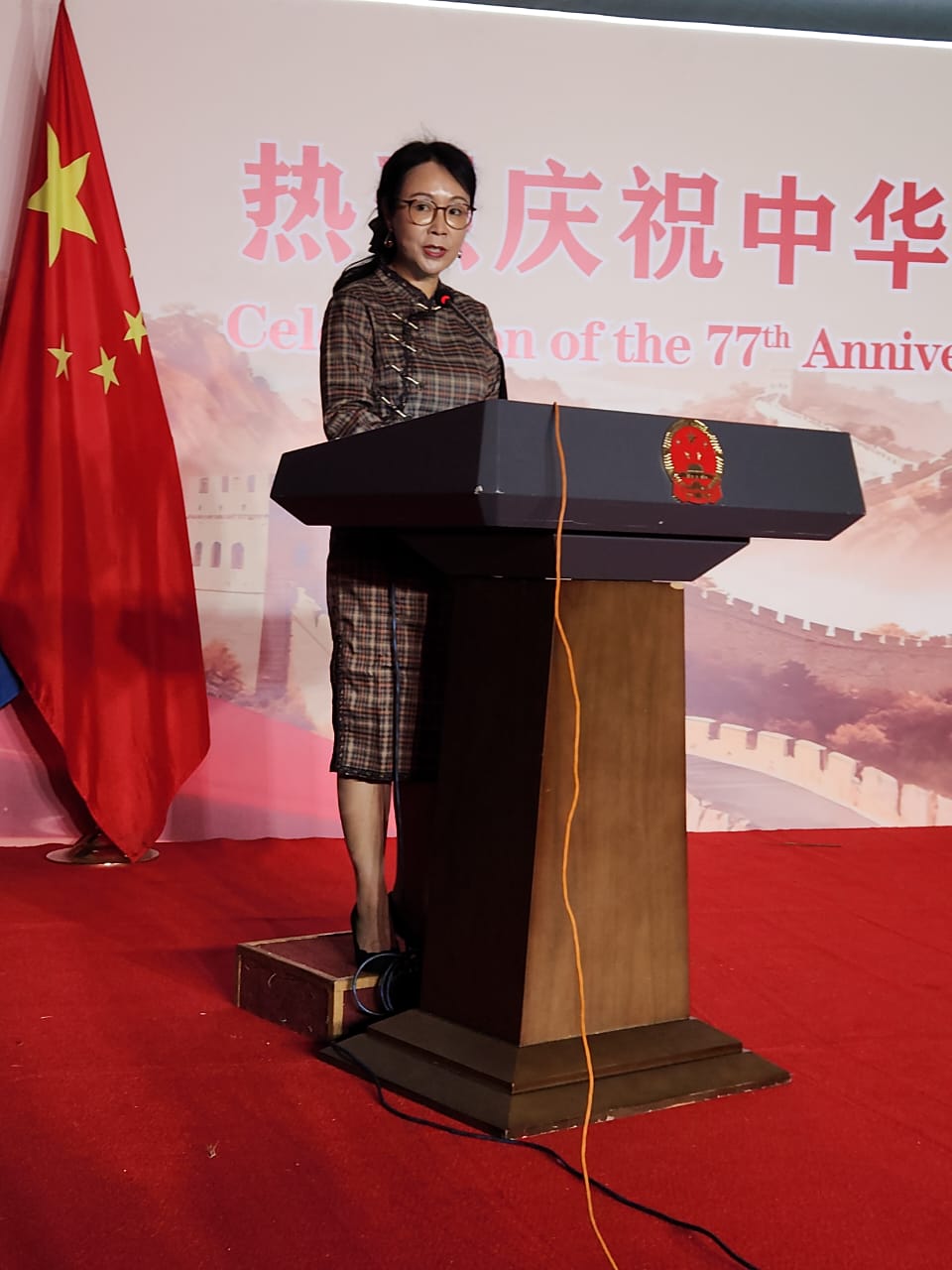
In Tanzania, that message carries particular resonance because the relationship between the two countries has continued to evolve alongside their respective development priorities.
Recent engagements between the two governments have placed strong emphasis on translating political trust into practical cooperation, with both sides highlighting areas including infrastructure, health, education, agriculture, green development and the digital economy.
The Chinese Embassy has also continued to describe people-to-people exchanges as an important dimension of the bilateral relationship, with cultural, educational, sporting and professional exchanges creating new opportunities for Tanzanians and Chinese citizens to understand one another more closely.
Kombo: Tanzania’s Commitment To A Longstanding Partnership
For Tanzania, the presence of Foreign Minister Mahmoud Thabit Kombo at the celebration carried diplomatic significance.
It reflected the importance Tanzania attaches to its relationship with China and the continuing engagement between the two governments.
The participation of the Foreign Minister also came at a time when Tanzania-China relations are being shaped by a new generation of cooperation—one that increasingly places economic transformation, investment, technology and sustainable development alongside the traditional pillars of political friendship.
The two countries have repeatedly expressed their commitment to strengthening bilateral cooperation and implementing agreements reached at the highest level.
In January 2026, Chinese Foreign Minister Wang Yi visited Tanzania, where he met President Samia Suluhu Hassan and held talks with Minister Kombo. The two sides described their relationship in terms of moving “from shared history to shared future” and agreed to deepen the Comprehensive Strategic Cooperative Partnership.

That engagement has provided another important platform for expanding cooperation between the two countries.
Beyond Diplomacy: Trade, Investment And Development
Perhaps the most visible transformation in Tanzania-China relations today is the increasing weight of economic cooperation.
China has become an important trading and investment partner for Tanzania, while Tanzanian businesses are increasingly looking towards the Chinese market.
Agricultural exports from Tanzania—including products such as sesame, honey, avocado, cassava and other commodities—have gained opportunities in China, creating prospects for Tanzanian farmers and exporters.
The broader ambition is to ensure that economic relations produce tangible opportunities for Tanzanians, particularly through increased exports, investment, technology transfer, skills development and industrialisation.
This is where the next phase of Tanzania-China relations could acquire even greater significance.
The question is no longer simply how much the two countries trade, but how effectively that trade can contribute to value addition, industrial development, employment and sustainable economic growth.
TAZARA: An Old Symbol With A New Chapter
Few projects capture the history of Tanzania-China relations as vividly as TAZARA.
Built during a different era, the railway remains a powerful reminder of the political solidarity that characterised the early relationship between China and newly independent African states.
Today, TAZARA is once again at the centre of renewed cooperation.
China and Tanzania, together with Zambia, have been working on the revitalisation of the railway, while a new training and operations control centre project has become part of that renewed effort. The Chinese Embassy has described the revitalisation of TAZARA as an important element of contemporary China-Tanzania cooperation.
The story is therefore moving from TAZARA as a symbol of historical friendship to TAZARA as an instrument of modern economic connectivity.
That transition perhaps captures the broader evolution of the bilateral relationship itself.
A Partnership Embracing The Future
The Tanzania-China relationship is also increasingly connected to sectors that did not feature prominently when diplomatic relations were first established.
Artificial intelligence, digital technology, green development, modern agriculture, financial technology, renewable energy, health innovation and advanced manufacturing are increasingly shaping the global economy.
For Tanzania, cooperation with China in these areas offers opportunities for knowledge exchange and access to technology and investment.
For China, Tanzania remains an important partner in East Africa, strategically positioned along the Indian Ocean and connected to a wider regional market.
The partnership is therefore increasingly regional in its economic implications, extending beyond bilateral relations to questions of East African integration, connectivity and development.
People At The Heart Of The Relationship
Yet diplomacy is ultimately about people.
Government agreements and infrastructure projects can establish the framework for cooperation, but lasting friendship is strengthened through the daily interactions of citizens.
Students studying in each other’s countries, businesspeople exploring new markets, journalists exchanging experiences, cultural groups performing together, athletes competing in friendship tournaments and professionals participating in training programmes all contribute to a relationship that exists beyond government offices.
The Chinese Embassy’s recent support for cultural and sporting exchanges, including the China-Tanzania Friendship Cup Table Tennis Competition, reflects this growing people-to-people dimension.
Such exchanges may appear modest compared with major infrastructure projects, but they help create something equally important: mutual understanding.
A Relationship Shaped By Mutual Respect
As Tanzania and China look ahead, the language of their relationship increasingly centres on partnership, mutual respect and shared development.
For Tanzania, maintaining a diversified network of international partnerships remains important as the country pursues its development ambitions.
For China, its relationship with Tanzania forms part of a wider engagement with Africa built around trade, investment, infrastructure, development cooperation and people-to-people links.
The two countries do not share identical histories, economies or development circumstances. What connects them is the recognition that cooperation can create opportunities that neither side would necessarily achieve alone.
That understanding has helped the relationship remain resilient through changing international circumstances.
From 77 Years Of China’s Journey To The Next Chapter Of Tanzania-China Friendship
The celebration of China’s 77th anniversary in Dar es Salaam therefore carried a meaning beyond the ceremonial.
It was a celebration of China’s national journey, but also an occasion to reflect on a bilateral relationship that has travelled from the era of independence and TAZARA to the age of digital technology, investment, modern infrastructure and global economic interdependence.
The presence of Foreign Minister Mahmoud Thabit Kombo alongside Ambassador Chen Mingjian underscored the continuing importance attached to the relationship by both sides.
As the evening reception brought together Tanzanians, Chinese citizens and members of the diplomatic community, the atmosphere reflected a relationship whose vocabulary has changed with the times but whose foundation remains familiar: friendship, mutual respect, solidarity and cooperation for development.
The next chapter will be judged not only by the number of agreements signed or projects launched, but by the extent to which the partnership translates into opportunities for ordinary people—through jobs, trade, education, technology, investment, innovation and stronger connections between the two societies.
From the railway lines that once symbolised solidarity to the digital and economic partnerships shaping tomorrow, Tanzania and China are writing a new chapter in a relationship that has endured across generations.
And as China marks 77 years since the founding of the People’s Republic, the celebration in Dar es Salaam offered a fitting reminder that some of the strongest international relationships are not defined only by what countries have achieved together in the past, but by what they continue to build together for the future.