



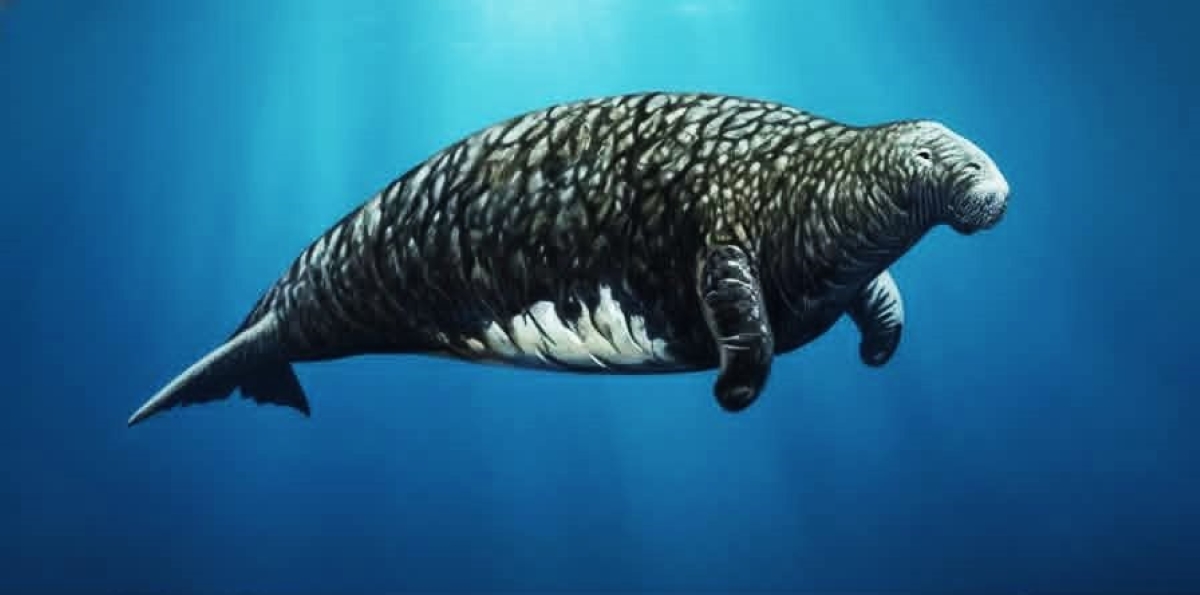
Her name was Steller’s sea cow, and for millennia, she was the quiet queen of a cold, kelp-filled kingdom.
When naturalist Georg Wilhelm Steller first described her in 1741, he beheld a marvel: a placid, ten-ton giant, nearly 30 feet long, grazing like a slow-moving mountain in the Arctic shallows.
The Sea Cow had survived ice ages and ocean upheavals, a relic of a gentler time.
Then, the world found her.
What happened next was not a hunt, but a systematic erasure.
Steller’s trusting nature, her predictable grazing grounds, and the rich, lasting quality of her meat and fat made her the perfect resource for sailors and fur traders.
They called her the “Arctic butcher shop”—a floating larder that could feed crews for weeks.
Within 27 years of Steller’s pen touching paper, the last sea cow was gone.
Her extinction was not a silent passing.
It was a thunderclap in the scientific mind.
Here was a creature, colossal and undeniable, observed by modern science—and then obliterated by modern commerce.
It forced a terrifying new idea into European thought: that humans could erase a species entirely.
This was decades before the word “conservation” entered the lexicon, and a century before Darwin framed life’s fragility in On the Origin of Species.
Her story is a wound that never healed. It is the archetype of human-driven extinction: a gentle, isolated giant, perfectly adapted to its world, and perfectly defenseless against ours.
She reminds the mankind that remoteness is not protection, and that wonder, once discovered, is often met not with stewardship, but with a harpoon.
The Sea Cow is gone.
But in her absence, she left a lesson written in salt and blood: that the line between discovery and destruction can be tragically, unforgivably thin.