



AI Technology Set To Bolster Agricultural Research In Tanzania As Experts Embark On Laboratory Trials

Tanzania has embarked on a strategy to use the Artificial Intellugence (AI) technology to perfect its agriculture research sector, the development which is projected to bring about notable success in the country’s crop production.
Up to last year, record shows that Tanzania had produced 22 million tonnes of food crops, pushing the country’s food adequacy to at least 130 percent.
With this production percentage, the country is now able to feed its population, and use the remaining 30 percent of its crop food surplus to market to other countries.
This milestone, among other is attributed to patriotic will by the Government of Tanzania to capacitate its agricultural institutions to develop improved seed varieties, modern technologies and imparting the crop growers with recommended practices.
The private sector has also been playing commendable role to supplement these efforts.
However, to further improving performance in the sector, the Tanzania Agricultural Research Institute (TARI), is now working to adopt the use of AI to hatch advanced agricultural technologies, as well as improved kernels.

Dr. Thomas Bwana
The Director General of TARI, Dr Thomas Bwana, told this publication that the state- owned seed researching institute has installed a tailor- made AI lab for the purpose.
He said the experts are currently working round the clock at the facility with an eye to invent high- yielding seed varieties and advanced technologies to help the farmers in the country to improve crops production and productivity.
The technologies to be produced, and the kernels, meant to assist farmers to overcome myriad challenges occuring at their respective crops producing zones, such as soil infertility and acidity, radical shifts in rainfall patterns, and other effects of climate change, according to him.
“The world is witnessing rapid innovation and technological adoption in the agricultural landscape, and thus, we’re also compelled to digitalize the sector in Tanzania for fruitful field results,” he expressed.
Dr Bwana expressed high optimism that professional adoption of AI technology will enable TARI to heighten and modenizing its research outcomes.
“We aim to develop more useful agro-technologies, both for seeds and agronomic practices,” he insisted.
He informed that, the institute had invented and developed a total of 443 important agricultural technologies by 2025, saying at least 312 of these focused on seeds.
Aknowledging technology as a major economic driver, Dr Bwana outlined the institute’s vision to develop vital innovations in seeds, value addition, farming practices, and artificial intelligence (AI), and to market these both domestically and internationally.
And in concerted efforts to have this vision materializing, he said TARI is focusing on enhancing staff capacity, upgrading laboratory infrastructure, and establishing multiple irrigation schemes.
“The chief objective is to hatch the improved technologies that address the numerous challenges farmers face, while also helping them achieve profitable returns,” Dr Bwana noted.
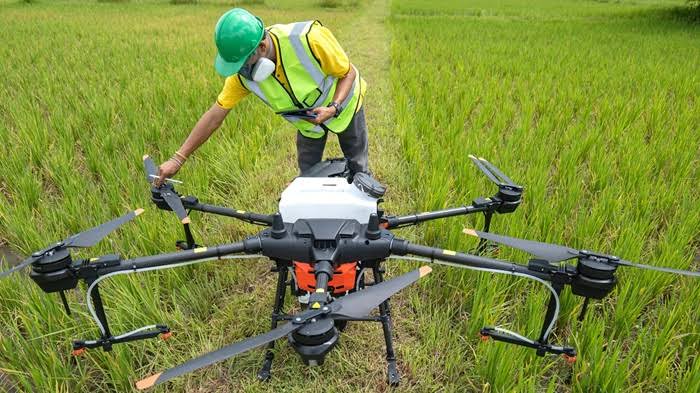
Tanzania is currently working to digitalizing its agricultural sector, which employs over 80 percent of the country’s population, by integrating digital tools, drones for surveillance, and IoT-enabled sensors in some areas.
So far, main advancements in this strategy include mobile-based extension services, such as M-Kilimo, GIS-based land planning, and climate-smart and drought-resistant crops.
The sector, agriculture, remains a backbone of Tanzania’s economy in 2026, driving growth alongside mining and construction.
The sector’s contribution towards the country’s Gross Domestic Product (GDP) is projected to reach up to 12.9 trillion this year.
Thriving of agriculture sector in Tanzania is fuelled by increased exports of some key economic cash crops, including coffee, tea, tobacco, and cashews.
The other factor is expansion in agro-processing, supported by the Agricultural Sector Development Programme (ASDP II).