
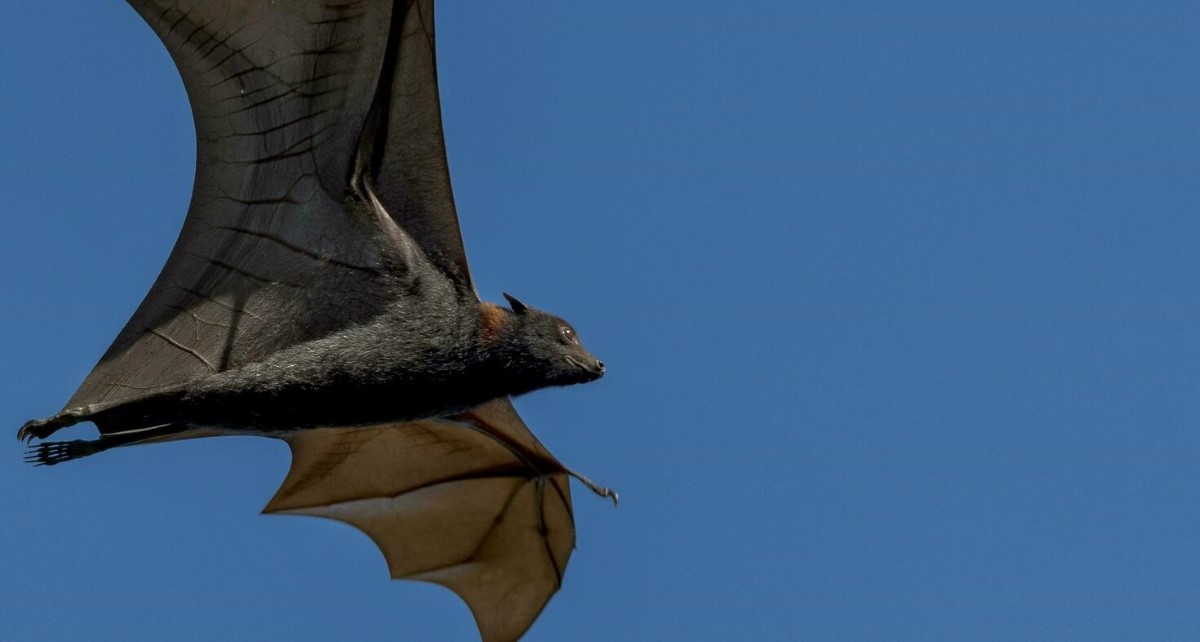
Egyptian Fruit Bats flying over Zanzibar Islands don’t depend on celestial bodies for navigation

Animals and humans rely on their navigation skills for movement and to survive.
However, spatial neurons in the brain’s ‘navigation circuit,’ had not previously been studied under real-world conditions.
Scientists conducted an electrophysiological study of spatial neurons in the wild using Egyptian fruit bats flying over Zanzibar Island across the Indian Ocean skyline.
They recorded head-direction cells from the presubiculum of bats flying unconstrained and navigating outdoors on a remote oceanic island.
Head-direction cells of the Egyptian fruit bats over Zanzibar Islands, were stable despite the dynamics of the moon and the stars.
These neurons represented the bats’ orientation stably across the island’s entire geographical scale and irrespective of the dynamics of the Moon and the Milky Way.
The directional tuning stabilized over several nights from the first exploration of the island.
These results imply that head-direction cells can serve as a learned, reliable neural compass for real-world navigation—highlighting the power of taking neuroscience out into the wild.
It was discovered that neural mechanisms underlying complex navigation behaviors have largely been studied in small-arena laboratory experiments, which are very different from real-world environments.
It is unknown whether the spatial cells discovered in the brain’s navigation circuit are relevant for real-world movement.
Lead scientist, Palgi said they recorded from single neurons in bats flying over an island and discovered that head-direction cells, neurons that encode an animal’s orientation, represent direction in a global, compass-like manner, not as a mosaic of local representations.
The research was conducted by 13 scientists from Israel, one from Germany, one from the mainland Tanzania and one based in Zanzibar.
The 13 researchers who took part in the study include Shaked Palgi, Saikat Ray, Shir Maimon, Yuval Waserman, Liron Ben-Ari, Tamir Eliav, Avishag Tuval, Chen Cohen, Liora Las and Nachum Ulanovsky, from the Department of Brain Sciences, at the Weizmann Institute of Science, in Rehovot, Israel.
Others are Julius Keyyu, from the Tanzania Wildlife Research Institute, of Arusha in Tanzania, Abdalla Ali of the Department of Natural Sciences, at the State University of Zanzibar, Zanzibar and TaHenrik Mounritsen from the Research Centre for Neurosensory Sciences, and Institut für Biologie und Umweltwissenschaften, Carl-von-Ossietzky Universität Oldenburg, Oldenburg, Germany.
Their findings establish the relevance of head-direction cells to real-world navigation. —Peter Stern
Apparently, animals and humans live in large and rich environments and need to navigate to find their way.
Navigation behavior outdoors has been studied extensively by ecologists and ethologists.
By contrast, the neural mechanisms of navigation have almost exclusively been studied indoors, in small laboratory settings, which are much smaller and contain poorer sensory information than real-world outdoor environments.
This leaves a major gap in our understanding of the neural basis of navigation: How does the brain’s “navigation circuit” operate in real-world conditions?
“In this study, we focused on head-direction cells—neurons that change their activity depending on an animal’s orientation and are often called “neural compasses,” they explained.
These neurons are well characterized in small environments but had not previously been studied in natural environments outdoors.
RATIONALE
Scientists set out to study head-direction cells in the wild by releasing Egyptian fruit bats to fly freely and navigate unconstrained on a small island near Zanzibar in East Africa.
They developed a miniaturized wireless recording device—a “neural logger”—that allowed tracking of the bats’ position and direction using a precise GPS and simultaneously recording the activity of multiple individual neurons.
Researchers conducted neural recordings in brain regions that are well known to contain head-direction cells.
They sought to differentiate between two competing hypotheses: the “mosaic hypothesis,” which predicts that each neuron will show different directional tuning in different areas of the island, depending on local sensory cues, and the “global compass hypothesis,” which predicts that each neuron will exhibit the same directional tuning across the entire geographical extent of the island.
Additionally, manipulating distant visual cues in laboratory experiments causes head-direction tuning to rotate, leading to a potential conundrum:
Do head-direction cells rotate their tuning outdoors upon movement of the Moon and stars, which are the most prominent distant visual cues outdoors? If so, then these neurons would form a highly unreliable neural compass for real-world navigation.
RESULTS
They discovered that head-direction cells in bats navigating on the island, which had similar functional properties to classical indoor head-direction cells.
These neurons maintained their directional tuning over a large geographical scale, consistent with the global compass hypothesis. In contrast, there was no compelling evidence for the mosaic hypothesis.
They further showed that head-direction cells remained stable both when the Moon was below the horizon and when the Moon and stars were occluded by clouds, which implies that the geographically stable tuning did not depend on the availability of these distant visual cues.
“We also ruled out a magnetic field–based origin of the neural compass. Finally, we found that the head-direction code stabilized slowly over several nights, suggesting a process during which bats gradually learned the layout of their environment, including the landmarks and geometry of the island.”
CONCLUSION
The results suggest that head-direction cells represent direction stably across geographical scales and irrespective of celestial dynamics and can therefore serve as the brain’s neural compass.
This study emphasizes the need to investigate the neural mechanisms of navigation in the wild. More generally, we call for broadening the scope of brain research toward neuroscience in the real world.
Head-direction cells recorded outdoors form a reliable neural compass for real-world navigation.
Experts performed single-unit neural recordings in animals navigating unconstrained in the wild—in bats flying outdoors on a remote oceanic island—and discovered that head-direction cells stably encode the animals’ orientation across the entire island, irrespective of the dynamics of the Moon and stars.