




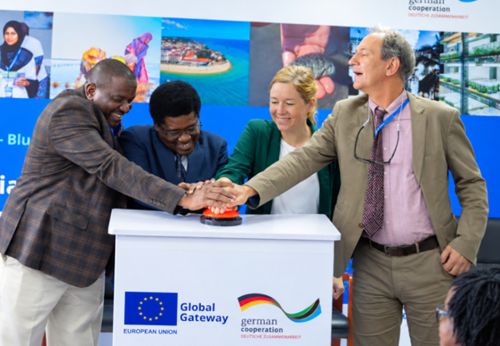
The European Union and Germany have committed €16.5 million ($18.4 million) to support tourism and aquaculture businesses in Tanzania through a programme designed to improve access to financing, markets and skills.
According to the EU Delegation to Tanzania, the StawiBluu programme was launched in Dar es Salaam on October 8, 2026. The EU is contributing €15 million, while Germany’s Federal Ministry for Economic Cooperation and Development is providing €1.5 million.
The German development agency GIZ will implement the programme across mainland Tanzania and Zanzibar.
StawiBluu will target tourism, aquaculture and mariculture businesses in Dar es Salaam, Bagamoyo, Unguja, Pemba and Mafia. Support will include business development services, investment readiness, access to finance, market connections and skills training.
The programme will also promote the processing of aquatic products and the development of more diversified tourism services.
The project is part of the broader €110 million Team Europe Initiative on Blue Economy for Jobs and Climate Action in Tanzania, under the EU’s Global Gateway strategy. The initiative brings together European and Tanzanian partners to promote sustainable investment, climate resilience and economic opportunities linked to marine and coastal resources.
The €110 million represents the budget of the wider initiative, which includes StawiBluu, rather than additional funding for the project.
Tourism Earnings Rise as Aquaculture Expands
The programme comes as Tanzania’s tourism sector continues to generate growing foreign exchange earnings. According to the National Bureau of Statistics’ 2025 International Visitors’ Exit Survey, tourism receipts increased 13 percent to $4.41 billion in 2025, compared with $3.90 billion in 2024.
International tourist arrivals rose 7.1 percent over the same period, from approximately 2.14 million to 2.29 million. Tourism earnings therefore grew faster than visitor numbers, highlighting the sector’s potential to generate additional revenue. StawiBluu aims to help tourism businesses strengthen their services, develop new products and improve access to customers, although the programme has not identified specific tourism segments expected to benefit.
Aquaculture is another sector targeted by the programme. According to the Food and Agriculture Organization (FAO), Tanzania produced approximately 138,607 tons of farmed aquatic products in 2024, including 94,977 tons of seaweed and 43,590 tons of finfish, alongside smaller quantities of other farmed species.
The FAO also reported significant growth in commercial cage fish farming, with the number of cages increasing from 50 in 2014 to 1,635 in 2024. However, small-scale farming in earthen ponds continues to account for most finfish production.
These different production systems face varying needs in financing, equipment, processing and access to markets.
StawiBluu’s support for investment readiness and business development is intended to help producers address some of these constraints and expand into higher-value activities.
Programme Targets Business Development and Market Access
Beyond increasing production, the programme will support businesses seeking to process aquatic products and improve their market access. Such activities can help producers capture more value from their output, although commercial success will depend on securing reliable buyers and meeting quality standards.
Tanzania’s wider fisheries sector also represents a substantial economic activity. The government’s 2024 Economic Survey recorded total fish harvests of 522,788 tons, valued at 4.35 trillion Tanzanian shillings, compared with 479,977 tons worth 3.36 trillion shillings in 2023.
These figures cover the broader fisheries sector and are not directly comparable with the FAO’s aquaculture production figures.
The survey also reported that 39,791.97 tons of fishery products received sanitary and phytosanitary export certificates in 2024, down from 42,592.03 tons in 2023.
The figures underline the importance of quality requirements and regulatory compliance for businesses seeking access to export markets.
While StawiBluu is expected to strengthen businesses’ access to financing and commercial opportunities, the EU’s launch announcement did not specify how many enterprises would receive support, how much financing would reach individual businesses or the amount of private investment the programme aims to mobilize.